Организаторы рассчитывают, что конференцию удастся провести в очном режиме. Если будут изменения – о них будет сообщео заблаговременно.
информационное письмо-приглашение – ниже.
Организаторы рассчитывают, что конференцию удастся провести в очном режиме. Если будут изменения – о них будет сообщео заблаговременно.
информационное письмо-приглашение – ниже.
Сегодня в четыре часа утра умер Ясен Николаевич. Прощание состоится в среду, 4 августа, во дворе журфака, с 12.30 до 13.30. Затем состоится кремация. Урна с прахом будет захоронена на Троекуровском кладбище.
Множество учеников Ясена Николаевича размещают у себя на страницах в интернете воспоминания, приходят слова памяти и от американистов, которые просят разместить их на нашем сайте.
Мы разместим тут все присланные на адрес larmih@gmail.com слова памяти о Я.Н. Засурском.
Первыми прислали соболезнования коллеги из Беларуси:
Неоценим его вклад в становление и развитие отделений журналистики, формирование редких направлений и научных школ в Забайкалье и на Дальнем Востоке, в том числе в Забайкальском государственном университете. В лице Ясена Николаевича мы потеряли выдающегося учёного, организатора, авторитетного деятеля в области международных отношений. Созданное под его началом Общество по изучению культуры США (ОИКС) и ежегодные конференции американистов-филологов, проводимые на факультете журналистики МГУ с 1975 года, способствовали объединению и сближению российских и зарубежных исследователей, развитию мировой науки.
Уход Ясена Николаевича – невосполнимая утрата, но его дело будет продолжено многочисленными учениками и последователями.
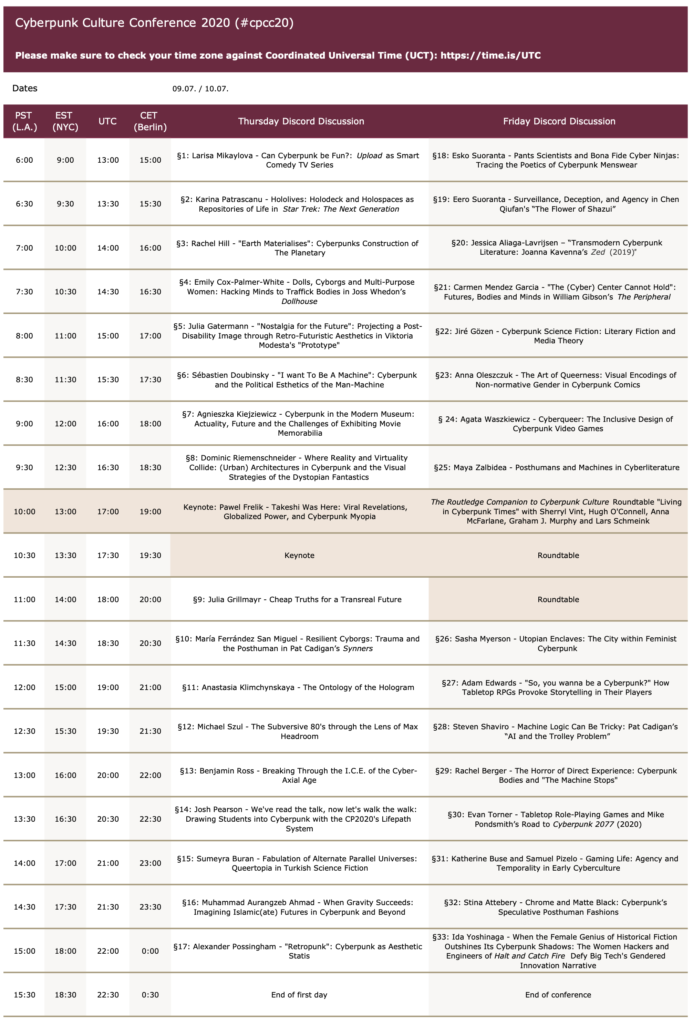
On July 9 and 10 you can register for free and take part in discussions according to the timetable with the presenters.
CPCC20 announces the keynote by Pawel Frelik on “Takeshi Was Here: Viral Revelations, Globalized Power, and Cyberpunk Myopia” to take place on Thursday, July 9th. For Friday, July 10th, the conference will host a roundtable discussion on “Living in Cyberpunk Times” featuring Sherryl Vint and Hugh O’Connell, as well as the editors of the Routledge Companion to Cyberpunk Culture (RCCC).
Program
We are glad to announce “Immigration and American Culture” as the theme of the XLV International conference of the Russian Society for American Culture Studies at Journalism Department of Lomonosov Moscow State University, in the hope that it will allow looking in more detail at the changing cultural landscape of the USA due to historical waves of immigration on the one hand, and at the complex influence of the present-day immigration policies on American culture, on the other.
The dates of the conference will be December 4-7, 2019.
Planned sections:
Round Table: Herman Melville’s Bicentenary (01.08.1819 – 28.09.1891)
Coordinators: Louisa P. Bashmakova, Prof. Emerita, KubSU, Krasnodar, Russia (888lpb@gmail.com), Prof. Andrew Wiget, Lomonosov MSU, and Prof. Emeritus, New Mexico State University, USA (andrew.wiget@gmail.com).
Melville’s contribution to the cultural and literary heritage of America and the world constitutes an immeasurable legacy. Themes for papers and conversations may vary from biographical issues to historical and theoretical arguments, literary interpretations, or the critical reception or artistic transformation of the writer’s works in the USA and abroad. Presentations of teaching Melville to students are especially welcome.
Coordinator: Ruslan Dokhov, MSU, Geography Department
Topics for discussion:
A traditional Round Table discussion: Imprints – Image of America and Image of Russia will also be held.
Темой юбилейной XLV Международной конференции Общества по изучению культуры США на факультете журналистики МГУ избрана «Иммиграция и культура Америки Immigration and American Culture», что позволит рассмотреть многие аспекты как исторического вклада различных волн иммиграции в американскую культуру, так и влияния современной непростой ситуации воздействия иммиграционной политики на культуру США.
Даты проведения конференции – 4-7 декабря 2019 года.
Предполагается работа секций:
– Журналистика США
– Культура Америки XVII-XIX веков в рамках которой пройдет Круглый стол, посвященным двухсотлетию со дня рождения Германа Мелвилла
– Американская культура ХХ-ХХI веков с Круглым столом по американской драме
– Этнические аспекты американской культуры
– Гендерные аспекты американской культуры
– Фантастическое в искусстве и культуре США
– Канадское измерение американской культуры
– Круглый стол
«Образ Америки и образ России: взаимовлияние».
Будет также работать секция “География
США и пространственные аспекты американской культуры / US Geography and
Spatial Aspects of American Culture”. Координатор Руслан Дохов
(Географический факультет МГУ) Примерные темы:
The Terra Foundation for American Art International Essay Prize recognizes excellent scholarship by a non-U.S. citizen working in the field of historical American art. Manuscripts should advance the understanding of American art by demonstrating new findings and original perspectives. The prize winner will be given the opportunity to work toward publication in American Art, the peer-reviewed journal copublished by the Smithsonian American Art Museum and the University of Chicago Press. The winner will receive a $1,000 cash award and a travel stipend of up to $3,500 to give a presentation in Washington, D.C., and meet with museum staff and research fellows.
Eligibility Requirements: Authors must be non-U.S. citizens who have achieved doctoral candidacy or completed a doctoral degree (or the equivalent), and have not previously had a manuscript accepted for publication in American Art. Essays may focus on any aspect of historical (pre-1980) American art and visual culture; however, architecture and film studies are not eligible. Essays may be submitted in any language; abstracts must be submitted in English.
Submissions for the 2019 prize must be sent to TerraEssayPrize@si.edu by January 15, 2019. For information on the prize, available in Chinese, English, French, German, Italian, and Spanish, please consult AmericanArt.si.edu/research/awards/terra.
Since the deadline for applications is November 30, 2018, we would like to remind you that the Graduate School of North American Studies (GSNAS) at Freie Universität Berlin will award
six three-year doctoral grants (1,350 EUR/month) and additional doctoral memberships (starting date: October 1, 2019) to students pursuing a doctoral project related to North America in Cultural Studies, History, Literary Studies, Economics, Political Science or Sociology.
Further details on our application platform and the deadline can be found on the attached posters and our website at gsnas.fu-berlin.de/en
Modern media culture is comprehensive, responding to the basic mass audience need in entertainment. The entertainment component is actively being introduced into the different spheres of media space, transforming traditional media formats. American journalism provides a lot of materials for analyzing various manifestations of comic forms. We could mention the musical and humorous program “Saturday Night Live” on the NBC channel, parodying political elite and received a TV Emmy award this year.
In the “Journalism” section 7 reports were made (out of 9 applications). Several reports were devoted to the genre peculiarity of the embodiment of the comic. Karine Chobanyan turned to the satiric rubric “RedicuList” of the information program “Anderson Cooper 360” on the CNN channel and defined it as an “informational feuilleton”. Svetlana Kanashina settled on the genre nature of popular Internet memes. She stressed the syncretic: textual and graphic components that outplaying the cliches of the American mass consciousness.
In the center of the next two reports was the figure of the USA President Donald Trump. Elena Pavlova emphasized the following important point: Trump appearance on the political arena marked a departure from the discourse of political correctness prevailing over the past decades. Annihilating irony and sarcasm were played a special role in departing from this established practice of public internal political polemics. In the Valery Terin message there was a thought that through Twitter Trump proposed a new type of electronic communication, different from the linear sequence of typographic culture.
The Nikolai Zykov report filled the usually vacant niche. It was dedicated to the “The Voice of America” broadcasting, combining literary and political humor.
Finally, two more reports were devoted to the print press. It is noteworthy that the appeal to the press was brought to the historical context. Yekaterina Zagvozdkina spoke about the ironic coverage in the late 1950s and early 1960s press the image of the “broken generation”, who had denied traditions and social norms.
In Yuliya Balashova report were determined the main stages of the American almanacs evolution, with their satirical variety accentuation. American almanacs developed mainly within the framework of popular and mass culture, invariably retaining their calendar prototype. Such diverse presidents of the United States, like Franklin Roosevelt, and then Richard Nixon, addressed the satirical almanac-calendar form, for the purpose of political PR.
Galina Lapshina summed up a certain result, drawing attention to the points of convergence of American and Russian culture.
Yulia Balashova
A Workshop Jointly Sponsored and Organized by the Obama Institute for Transnational American Studies and the Society of Early Americanists October 4-6, 2018 Johannes Gutenberg University, Mainz, Germany
SUBMISSIONS
Please email the following materials to the Workshop Chair, Prof. Oliver Scheiding (scheiding@uni-mainz.de) as PDF attachments byFebruary 15, 2018:
Workshop acceptances will be sent out by March 15, 2018.
Details in the attached document