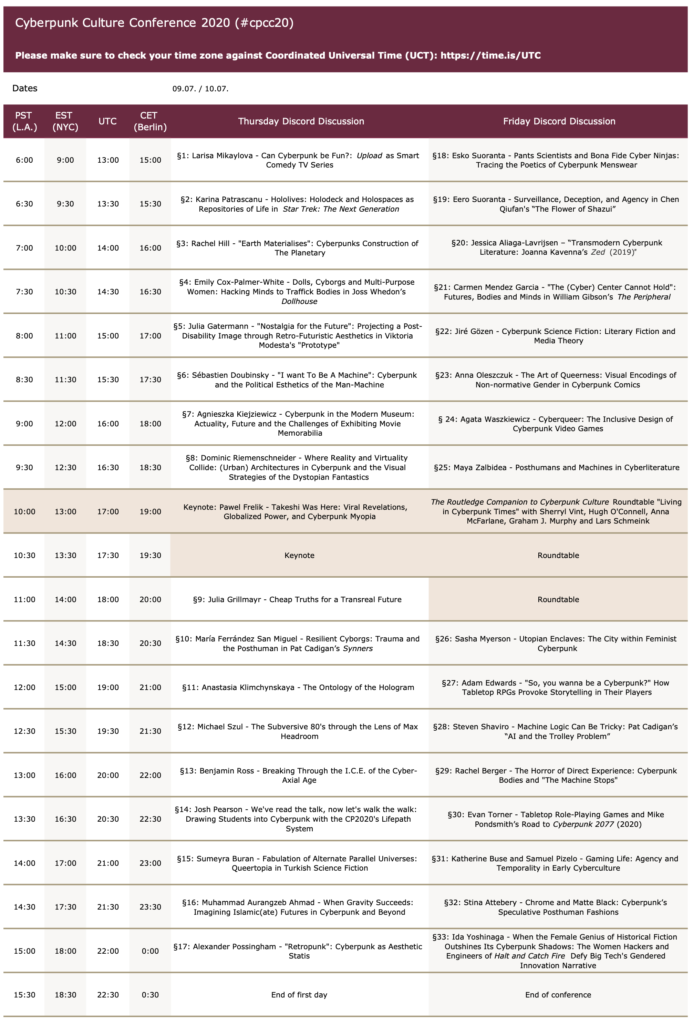
July 9-10, 2020 Online Conference Cyberpunk and Culture

All the presentations are already online and  will remain online at http://cyberpunkculture.com/  as a valuable resource for contemporary culture studies

On July  9 and 10 you can register for free and take part in discussions according to the timetable with the presenters.

Keynote & Roundtable

CPCC20 announces the keynote by Pawel Frelik on “Takeshi Was Here: Viral Revelations, Globalized Power, and Cyberpunk Myopia” to take place on Thursday, July 9th. For Friday, July 10th, the conference will host a roundtable discussion on “Living in Cyberpunk Times” featuring Sherryl Vint and Hugh O’Connell, as well as the editors of the Routledge Companion to Cyberpunk Culture (RCCC).

Program

Форма проведения ежегодной международной конференции ОИКС в 2020 году

На данный момент – июль 2020 – сохраняется вероятность очного проведения конференции в намеченные на декабрь с.г. сроки. Если ситуация изменится – она будет проведена онлайн с применением платформ Зум или Скайп.

Регистрация будет на платформе Ломоносов с 15 августа по 5 октября.

RSACS XLVI International Conference Theme

The theme of the XLVI International conference of the Russian Society for American Culture Studies at Journalism Department of Lomonosov Moscow State University will be “White, Silver and Black Mirrors: ‘Screening’ of American History and Dreams”

Cinematic and TV representation of any aspects of American culture will become for the first time the focus of analysis at our multidisciplinary conference.

The dates of the conference will be December 2-5, 2020.

Planned sections:

  • – Journalism,
  • – American Culture of the 17-19th Centuries,
  • – Contemporary Literature and Culture, with a Round Table Discussion on American Drama
  • – Ethnic Aspects,
  • – Gender Studies,
  •  Fantastic in the Arts, with Round Table  dedicated to Ray Bradbury’s Centennial
  •  Canadian perspectives, 

A traditional Round Table discussion: Imprints – Image of America and Image of Russia will also be held.

Additional panel discussions suggestions are accepted until March 15, 2020 at larmih@gmail.com Registration link will be made available at March 30.  

Тема конференции ОИКС 2020 года

Тема XLVI Международной конференции Общества по изучению культуры США  «Экранная история США: мечта, документ, интерпретация – White, Silver and Black Mirrors: ‘Screening’ of American History and Dreams». Впервые все наши секции будут работать с привлечением материала художественного и документального кино, телевизионных шоу и телефильмов.

Конференция состоится  со 2 по 5 декабря 2020 года на факультете журналистики МГУ имени М. В. Ломоносова (Москва, Моховая, 9). Прием тезисов откроется на портале “Ломоносов” в апреле 2020 года. Ссылка  для регистрации будет опубликована 30 марта.

Предполагается работа секций:

— Журналистика США

— Культура Америки XVII-XIX веков

— Американская культура ХХ-ХХI веков с Круглым столом по американской драме

— Этнические аспекты американской культуры

— Гендерные аспекты американской культуры

— Фантастическое в искусстве и культуре США с круглым столом к 100-летию со дня рождения Рэя Брэдбери

— Канадское измерение американской культуры

— Круглый стол «Образ Америки и образ России: взаимовлияние».

До 20 марта принимаются предложения по проведению панельных дискуссий, круглых столов и секций по адресу larmih@gmail.com

Для организации дискуссии и круглого стола требуется представить список вопросов по-русски и по-английски и назвать трёх участников. Для секции – представить концепцию секции.


Deadline for EAAS Biennial conference in Warsaw extended till December 15

There are a few extra days for those who consider participating this year. And new members of RSACS are strongly encouraged to apply already this year, starting participating in EAAS activities. Please see below the information about the conference. The link to the conference website is also in the end.

2020 EAAS Conference — 20/20 vision

2020 EAAS Conference — Warsaw, May 1–3, 2020 20/20 vision: Citizenship, Space, Renewal EAAS 2020 Conference coincides with the 400th anniversary of the establishment of the Plymouth Plantation. Falling on the quadricentennial, EAAS 2020 invites broader contemplations of American history, politics, and culture. The conference seeks to underscore questions of optics, distance, and acuity. The concept of “20/20 vision,” an optical term denoting “normal” visual clarity and sharpness of sight, invites a reflection on historical distance, focal points, visibility and invisibility of socio-historical, cultural, and literary aspects of American citizenship, space, and renewal until today. Citizenship The first thematic scope of “20/20 Vision” is citizenship. We thus welcome papers targeting the idea of citizenship from various historical, political, ethical, and aesthetic perspectives, and addressing questions about the archaic, residual or emergent forms, styles and norms of being a citizen. Papers and pre-formed panels may focus on the following problem points:
  • the evolution or devolution of the idea of a democratic citizen in American politics
  • legal fiction, the citizen, and citizenship in history and literature
  • the problems of citizenship and agency in the days of the early Republic
  • the relation between citizenship and economy
  • citizenship and mobility
  • citizenship and migration
  • citizenship and slavery
  • citizenship and disability
  • citizenship and the changing idea of freedom
  • citizenship and community
  • civil rights
  • limits of responsibility
  • limits of engagement
Space The second theme “20/20 Vision” addresses is space, a general umbrella term for the issues related to the environment:
  • land exploration and exploitation in the US
  • American history of land property
  • US borderland issues
  • US problem of natural resources
  • climate change and the US policy
  • climate change and the American landscape
  • pollution and toxic waste
  • ecological disasters
  • space exploration
The theme of space also relates issues connected with spatiality on 
a different dimension such as the issues of
  • private vs public space
  • social media and internet space
  • architecture, mortgage problem
  • rural vs. urban space
  • utopias in American history, politics and literature
  • dystopias in American history, politics and literature
  • American heterotopias
Renewal The last focus area of “20/20 Vision” is perhaps the broadest of the three: the idea of renewal. While strongly related to the issues of citizenship and space, where it may also serve as a reflective angle, the theme of renewal on its own relates to a strong appeal in the American culture of the discourse of rebirth, reawakening, and revolution. Long before “make it new” became the slogan of the modernist artists on both sides of the Atlantic, making things new and resetting the parameters had always been part of the American life ethos. We welcome individual papers as well as pre-formed panels. Submissions We welcome abstracts and proposals in a range of formats, including individual papers; complete three-paper sessions (do note that
 a proposed session cannot feature scholars from the same institution and the same country); roundtables; and workshops. Individual paper abstracts should be no longer than 350 words (excluding bibliography, if you choose to have one). Session proposals must include a short description of the session as well as the title and abstracts of all three papers. Deadline for abstracts: December 15, 2019 Acceptance notifications: January 6, 2019
http://eaas2020.eu/

Deadline for EAAS Biennial conference in Warsaw extended till December 15

There are a few extra days for those who consider participating this year. And new members of RSACS are strongly encouraged to apply already this year, starting participating in EAAS activities. Please see below the information about the conference. The link to the conference website is also in the end.

2020 EAAS Conference — 20/20 vision

2020 EAAS Conference — Warsaw, May 1–3, 2020 20/20 vision: Citizenship, Space, Renewal EAAS 2020 Conference coincides with the 400th anniversary of the establishment of the Plymouth Plantation. Falling on the quadricentennial, EAAS 2020 invites broader contemplations of American history, politics, and culture. The conference seeks to underscore questions of optics, distance, and acuity. The concept of “20/20 vision,” an optical term denoting “normal” visual clarity and sharpness of sight, invites a reflection on historical distance, focal points, visibility and invisibility of socio-historical, cultural, and literary aspects of American citizenship, space, and renewal until today. Citizenship The first thematic scope of “20/20 Vision” is citizenship. We thus welcome papers targeting the idea of citizenship from various historical, political, ethical, and aesthetic perspectives, and addressing questions about the archaic, residual or emergent forms, styles and norms of being a citizen. Papers and pre-formed panels may focus on the following problem points:
  • the evolution or devolution of the idea of a democratic citizen in American politics
  • legal fiction, the citizen, and citizenship in history and literature
  • the problems of citizenship and agency in the days of the early Republic
  • the relation between citizenship and economy
  • citizenship and mobility
  • citizenship and migration
  • citizenship and slavery
  • citizenship and disability
  • citizenship and the changing idea of freedom
  • citizenship and community
  • civil rights
  • limits of responsibility
  • limits of engagement
Space The second theme “20/20 Vision” addresses is space, a general umbrella term for the issues related to the environment:
  • land exploration and exploitation in the US
  • American history of land property
  • US borderland issues
  • US problem of natural resources
  • climate change and the US policy
  • climate change and the American landscape
  • pollution and toxic waste
  • ecological disasters
  • space exploration
The theme of space also relates issues connected with spatiality on 
a different dimension such as the issues of
  • private vs public space
  • social media and internet space
  • architecture, mortgage problem
  • rural vs. urban space
  • utopias in American history, politics and literature
  • dystopias in American history, politics and literature
  • American heterotopias
Renewal The last focus area of “20/20 Vision” is perhaps the broadest of the three: the idea of renewal. While strongly related to the issues of citizenship and space, where it may also serve as a reflective angle, the theme of renewal on its own relates to a strong appeal in the American culture of the discourse of rebirth, reawakening, and revolution. Long before “make it new” became the slogan of the modernist artists on both sides of the Atlantic, making things new and resetting the parameters had always been part of the American life ethos. We welcome individual papers as well as pre-formed panels. Submissions We welcome abstracts and proposals in a range of formats, including individual papers; complete three-paper sessions (do note that
 a proposed session cannot feature scholars from the same institution and the same country); roundtables; and workshops. Individual paper abstracts should be no longer than 350 words (excluding bibliography, if you choose to have one). Session proposals must include a short description of the session as well as the title and abstracts of all three papers. Deadline for abstracts: December 15, 2019 Acceptance notifications: January 6, 2019
http://eaas2020.eu/

Deadline for EAAS Biennial conference in Warsaw extended till December 15

There are a few extra days for those who consider participating this year. And new members of RSACS are strongly encouraged to apply already this year, starting participating in EAAS activities. Please see below the information about the conference. The link to the conference website is also in the end.

2020 EAAS Conference — 20/20 vision

2020 EAAS Conference — Warsaw, May 1–3, 2020

20/20 vision: Citizenship, Space, Renewal

EAAS 2020 Conference coincides with the 400th anniversary of the establishment of the Plymouth Plantation. Falling on the quadricentennial, EAAS 2020 invites broader contemplations of American history, politics, and culture. The conference seeks to underscore questions of optics, distance, and acuity. The concept of “20/20 vision,” an optical term denoting “normal” visual clarity and sharpness of sight, invites a reflection on historical distance, focal points, visibility and invisibility of socio-historical, cultural, and literary aspects of American citizenship, space, and renewal until today.

Citizenship

The first thematic scope of “20/20 Vision” is citizenship. We thus welcome papers targeting the idea of citizenship from various historical, political, ethical, and aesthetic perspectives, and addressing questions about the archaic, residual or emergent forms, styles and norms of being a citizen. Papers and pre-formed panels may focus on the following problem points:

  • the evolution or devolution of the idea of a democratic citizen in American politics
  • legal fiction, the citizen, and citizenship in history and literature
  • the problems of citizenship and agency in the days of the early Republic
  • the relation between citizenship and economy
  • citizenship and mobility
  • citizenship and migration
  • citizenship and slavery
  • citizenship and disability
  • citizenship and the changing idea of freedom
  • citizenship and community
  • civil rights
  • limits of responsibility
  • limits of engagement

Space

The second theme “20/20 Vision” addresses is space, a general umbrella term for the issues related to the environment:

  • land exploration and exploitation in the US
  • American history of land property
  • US borderland issues
  • US problem of natural resources
  • climate change and the US policy
  • climate change and the American landscape
  • pollution and toxic waste
  • ecological disasters
  • space exploration

The theme of space also relates issues connected with spatiality on 
a different dimension such as the issues of

  • private vs public space
  • social media and internet space
  • architecture, mortgage problem
  • rural vs. urban space
  • utopias in American history, politics and literature
  • dystopias in American history, politics and literature
  • American heterotopias

Renewal

The last focus area of “20/20 Vision” is perhaps the broadest of the three: the idea of renewal. While strongly related to the issues of citizenship and space, where it may also serve as a reflective angle, the theme of renewal on its own relates to a strong appeal in the American culture of the discourse of rebirth, reawakening, and revolution. Long before “make it new” became the slogan of the modernist artists on both sides of the Atlantic, making things new and resetting the parameters had always been part of the American life ethos. We welcome individual papers as well as pre-formed panels.

Submissions

We welcome abstracts and proposals in a range of formats, including individual papers; complete three-paper sessions (do note that
 a proposed session cannot feature scholars from the same institution and the same country); roundtables; and workshops. Individual paper abstracts should be no longer than 350 words (excluding bibliography, if you choose to have one). Session proposals must include a short description of the session as well as the title and abstracts of all three papers.

Deadline for abstracts:

December 15, 2019

Acceptance notifications:

January 6, 2019

http://eaas2020.eu/

XLV RSACS Conference “Immigration and American Culture” SCHEDULE December 4-7, 2019

Day Section room
December 4, Wednesday
10.00-13.00 16.00-17.30
  18.00-20.00
Registration
 
Opening Plenary Session
217
233
20.00-21.00 Tea and Pirozhki 217
December 5, Thursday
12.30 – 14.30   Section 5. Gender Aspects of American Culture             217
14.30 – 15.00 Lunch break  
15.00 – 18.00 Section 1. Journalism 217
17.30-19.00 Round Table discussion “Herman Melville Bicentennial” 103
December 6, Friday    
10.30 – 13.00 Section 3. Contemporary American Literature and Culture 217
13.00 –14.00 Lunch break
14.00 – 16.00  
16.30 – 19.00
Section 4. Ethnic Aspects of American Culture 320
16.00 – 16.30 Кофе-брейк 217
14.00 – 16.00
  16.30 – 19.00
Section 8. Geography of the US and Spatial Aspects of
American Culture  
103
December 7, Saturday    
10.00 – 11.30 Section 6.  Fantastic in the Arts   217
11.30 –12.00 Lunch break
12.00 – 13.30 Section 7. Canadian Dimension of American Culture 217
13.30 – 14.00 Coffe-break 217
14.00 – 18.30 Round Table discussion «Imprints: Image of Russia and
Image of America»
103
18.30 – 19.30 Closing Plenary Session 103
20.30 – 21.30 Farewell dinner кафе

Расписание XLV Международной конференции ОИКС “Иммиграция и культура США”

день секция аудитория
4 декабря, среда
10.00-13.00
16.00-17.30
18.00-20.00    


Регистрация
 
Открытие Пленарные доклады  
217

233  
20.00-21.00 Чай с пирогами 217
5 декабря, четверг
12.30 – 14.30   Секция 5. Гендерные аспекты американской культуры             217
14.30 – 15.00 Перерыв на обед  
15.00 – 18.00 Секция 1. Журналистика 217
17.00-19.00 Круглый стол “К 200-летию Германа Мелвилла”   103
6 декабря, пятница    
10.30 – 13.00 Секция 3. Современная литература и культура XX-XXI вв. 217
13.00 –14.00 Перерыв на обед
14.00 – 16.00
 16.30 – 19.00
Секция 4. Этнические компоненты культуры США 320
16.00 – 16.30 Кофе-брейк 217
14.00 – 16.00
16.30 – 19.00
Секция 8. География США и пространственные
аспекты американской культуры  
103
7 декабря, суббота    
10.00 – 11.30 Секция 6.  Фантастическое в искусстве и культуре США   217
11.30 –12.00 Перерыв на обед
12.00 – 13.30 Секция 7. Канадское измерение американской культуры 217
13.30 – 14.00 Кофе-брейк 217
14.00 – 18.30 Круглый стол
«Образ России и образ Америки: взаимовлияние
103
18.30 – 19.30 Закрытие конференции 103
20.30 – 21.30 Дружеский ужин кафе

Program of the XLVth RSACS International Conference

December 4, Wednesday, 6 pm  Room 233

Plenary Opening Session

  1. Professor Yassen Zassoursky

RSACS President, President of Journalism Department,

Lomonosov Moscow State University, Russia

Welcome speech

2. Professor.Andrew Wiget

Albuquerque University, USA

Moby-Dick: Melville on Demons, Demagogues and Democracy

3. Professor Pavel Balditsyn

Journalism Department,

Lomonosov Moscow State University, Russia

The Way and the Fate of Chinese Immigrants in the USA in Images of the Chinese-American Literature

The object of the address is to comprehend the secret of Chinese immigrants’ success in the USA. Immigration is often tragic, Chinese immigration at the beginning was a double tragedy. It meant to lose their native names and relatives, their own ancient language and culture. They were humiliated and despised in America, depicted as aliens and “The Yellow Peril” and forbidden the country for long sixty years. But in some decades after the abolition of the infamous Exclusion act Asian immigrants were called “The Model Minority”.

What is the explanation of such an achievement? Chinese immigrants in the USA kept true to their traditional rules and values: “golden mean”, “to live in harmony with others”, “harmony but not sameness”, “to seek common ground while reserving differences”. One more slogan was: “The weak shall conquer”. They need to submit in circumstances of assimilation. At the same time Chinese migrants desired to become real Americans and to take principles of personal freedom and equality of all people, self-reliance and individualism, justice and democracy. Their strategy was to gain two homelands – China and America and to get twofold pride and patriotism. It was not a simple task. There were many losses and deaths, but love prevailed. Love to both countries and cultures. This way put a total overturn of traditional gender and generation roles of China, a hyphenated discourse and poetics of Chinese-American literature which use paradoxes and oxymorons, like that: “We are Americans now, we live in the tundra / Of the logical, a sea of cities, a wood of cars”.

Round Table Discussion “Bicentennial of Herman Melville”

Coordinators Dr. Louisa Bashmakova (Krasnodar, Russia) and  Dr. Andrew Wiget (Albuquerque, USA)

1.Andrew Wiget

Albuquerque University, USA

Moby-Dick: Melville on Demons, Demagogues and Democracy

Most readers who manage to finish reading Herman Melville’s Moby-Dick conclude perhaps that  the essence of the story is the obsessive hunt by a mad captain Ahab who seeks revenge on a particular white whale who had bit off his leg.  In my experience, modern readers are either puzzled, annoyed, frustrated or defeated by the book. They want to get on with the chase, for which they have been made to wait 35 chapters until “The Quarterdeck” scene, when the manic plan is revealed, after which the climactic confrontation is postponed by another 98 chapters, which scatter among the narrative many chapters of exposition describing the business and technical aspects of whaling, whose only purpose seems to be to add length and not substance to the book.  Such a reading reflects at best an unprepared reader, at worst a juvenile one. It is my purpose to argue precisely for the value of Moby-Dick as a literary masterpiece that, while addressing the concerns of  Melville’s age, also speaks directly to the most urgent questions of our time:  not only the present war on nature, that takes many forms from climate change to the extinction of species, but more importantly to the dangerous political relations that make such a war possible. 

Two broad historical trends must frame any reading of Moby-Dick.  First, between 1820 and 1850 the new United States of America expanded westward  across the continent to its western shores, and thence to the furthest reaches of the Pacific Ocean and the Arctic.  During the same period, the population multiplied three times in 30 years, much of it through a massive increase in immigration.  The second was the growth of industrial capitalism, which by the end of the century would make the United States the most industrialized nation on earth.  These two trends sustained the rise of American imperialism, which was driven by violence against Nature, the successful destruction which validated America’s Manifest Destiny, in what Richard Slotkin so aptly called, “regeneration through violence.”

The anxieties and contradictions of antebellum America, which would eventually erupt in Civil War, were very close to Melville, who had the early sympathies of a Jacksonian Democrat.  He brought these anxieties and contradictions aboard the ship called Pequod, aptly named after the bloodiest seventeenth-century Puritan massacre of Indians. Any reading of the novel which overlooks these matters and prefers to “cut to the chase”, is both sterile and  juvenile.  For Melville, the voyage of the Pequod  in Moby-Dick is the sailing forth of the United States, burdened by the nightmares of its past, enchanted by its vision of the future, and struggling all the while to understand what kind of leader is required to make democracy just and humane on the one hand and profitable on the other.

2. Alla Nikulina

Akmulla Bashkir State Pedagogical University, Ufa, Russia

Herman Melville as a Pioneer of the U.S. Philosophical Novel

 Although the American mind was never inclined to abstract theorizing, the philosophical novel as a genre appeared in the U.S. national literature at an early stage of its development. H. Melville’s ‘Moby-Dick’ can be classified as a philosophical novel due to its deep consideration of the reality based on metaphysical theories, which are investigated and promoted by the author at all levels of the artistic whole. Western and Russian literary critics made several attempts to single out the dominant concept, connecting it to the philosophy of Spinoza, Emerson, Schelling, Schopenhauer, and even Wittgenstein, whose discoveries, according to K. Evans, Melville anticipated by a century. Anyway, we cannot fail to see Melville’s desire to rely upon well-established philosophical concepts in his investigation of the essence of the world, but we notice, first, that the writer centers his attention on the human rather than the universal, i.e. on practical and ethical consequences of accepting a certain abstract worldview. Besides, realizing the limits of ready-made concepts, Melville strives to reshape them in order to create his own original system. Characteristically, the later development of the genre in the American literature will be dominated by a similar approach, with the emphasis on pragmatic values, synthesis of various philosophic traditions and individual intellectual search.

3. Kirill Ignatov

Department of Foreign Languages and Area Studies,

Lomonosov Moscow State University, Russia

Herman Melville in a University Course of US literature: From Screen to Novel

Herman Melville is one of the most popular 19th-century authors among university students in the course of US literature, since the exciting plot of his novels does not limit the text to adventure escapism, which imposes ‘age restrictions’ on, for example, some works of J.F. Cooper or Mark Twain. On the contrary, Melville’s novels due to their multi-layered nature offer opportunities for a variety of readings and a plethora of interpretations. This is reflected in the history of adaptations of the main works of Melville: Moby Dick, Bartleby, Billy Bud, Benito Cereno and others. The popularity of Melville’s works among filmmakers can be used in teaching US literature to encourage students to work independently with the text of the novel. The talk presents approaches based on the principle of indirect goal-setting, which can be used in the US Literature course to stimulate close reading of the novel, independent extracurricular work of students, and collective creativity. The novel ‘Moby Dick’ and its various adaptations are used to illustrate the approaches: from Millard Webb’s silent tape Sea Beast (1926) through the classic British version of John Huston Moby Dick (1956) to Trey Stokes’s modernized version in the form of action movie Moby Dick (2010).

4. Louiza Bashmakova

Kuban State University, Krasnodar, Russia

An April the 1st Showboat on Mississippi: on H. Melville’s Genre Singularity in Confidence-Man

The object of this discourse is Melville’s deep rootedness in genres and forms of American folk and popular culture. The writer’s art of high comedy attracts special attention, with an accent on analysis of Melville’s technique of burlesque, travesty, and grotesque. Principles of comparative literature studies are suggested as the base for analogies with the poetic ideas of Melville’s great predecessors – Cervantes, Shakespeare, Molière, Goethe.

5. Vladislav Alekseenko

Altai State Pedagogical University, Linguistic Institute, Barnaul, Russia

The Conceptual System of the World in Herman Melville’s novel Moby Dick, or The Whale

Nowadays conceptual study of images in the literary text is important to reveal the author’s idea. In Herman Melville’s novel Moby Dick, or The Whale it is manifested in the selection of concepts reflected in the writer’s work, in his individual works and in the selection of expressive and visual means. In linguistics, the Conceptual System of the world (CS) is understood as a reflected reality through the prism of concepts formed on the basis of human perceptions of the real world. A unit of the CS is a concept – the content of the concept in the distraction from the language form of its expression, which function is to fix and actualize the conceptual, emotional, associative, verbal, culturological and other content of the objects of reality, included in the CS structure. The mechanism of CS construction and the role of language in these processes were discovered by Rolandas Pavilionis, analyzing the conceptual system of the world from a logical and philosophical point of view. The conceptual system is characterized by the following properties: order of introduction of concepts; continuity of conceptual system construction; continuity of conceptual system. The language means of CS creation are: nominal language means; grammar means of language; figurative means; discursive means; phonosemantics of language. CS with components included in it can be explicated in various ways: as logical and verified tables and diagrams; frames and concepts. The analysis of Herman Melville’s work allows us to speak about the special importance of such basic concepts as «challenge» and «revenge» for the writer. The method of semantic expansion allows us to identify the semantic field of the “challenge” concept, including such units as «struggle», «test», «dare», «dispute», «face», «confrontation», «summon», «try», while the “revenge” concept includes lexical representations of the concepts of «vengeance», «retribution», «vindictiveness», «avenge». Moby Dick is understood as something that can be very desirable, or a goal that must be achieved: the author makes it clear that the captain Ahab intends to pursue the whale across all seas around the world. Other key concepts of the novel are «human obsession» and «destiny», based on the idea of revenge and persecution of inevitable death. Besides, the entire novel is filled with biblical imagery: the artistic form of the work and the biblical names of the characters emphasize the philosophical concepts. Interpretable as forms of public consciousness, they form the CS of the entire work.

6. Anna Doolina

Philological Department

Lomonosov Moscow State University, Russia

«What my own astonished eyes saw…»: The Unreliable Narrator in H. Melville’s Short Stories

H. Melville’s short stories bring to the fore the problem of an unreliable narrator. The narrators in the short stories are often sick. The style and rhetoric of the narrative in the short stories depend directly on the narrator’s temper, and the narrative strategy of each of the stories is determined by their “clinical records”. It forms the second level of the story – about the development of the narrator’s obsessive state. Before meeting face-to-face with the striking phenomenon, the narrators find themselves already endowed with unusual sensitivity due to their physical deterioration (the narrator of The Piazza travels to the mountains after a serious disease, the narrator of the story Cock-a-Doodle-Doo! is also sick). Then, in contact with the object described, the narrators are so strongly influenced that they are no longer able to think clearly, they are “blinded”, become obsessed with what they once saw or heard, their narrative is invaded by long intrusive series of enumerations and repetitions. For example, the formula “I prefer not to” becomes contagious in Bartleby; in Poor Man’s Pudding and Rich Man’s Crumbs the narrator is exposed to the phrases of the poor. Thus, the repetitive phrases of the narrators, undergoing a semantic transformation, form the composition of Melville’s short stories and are in most cases associated with the images and theme of the disease, making the narrators of the short stories unreliable.

Round Table Discussion “Imprints: Image of America and Image of Russia”

Coordinator Professor Yassen Zassoursky (Journalism Department, Lomonosov Moscow State University, Russia)

Continue reading